 How-to
How to Build a Wedding Media Backup Plan That Protects Every Moment
Last Updated: November 24, 2026
Quick Summary
A wedding media backup is important because photos and video record moments that cannot be repeated, and a single card failure, overwritten file or lost drive can erase them for good. Build redundancy into capture with dual-card recording, then follow the 3-2-1 rule: three copies, on two types of media, with one kept off-site.
- Shoot on dual-card cameras so each frame is written twice during the ceremony.
- Copy cards to a first portable drive, then a second, at the reception.
- Upload a third copy to encrypted cloud storage on the same night.
- Verify file counts and open a sample from each card before reformatting.
- Never wipe a card until you have opened files from every copy.
Table of Contents
- Why is a wedding media backup plan important?
- The wedding photo backup workflow, from ceremony to final delivery
- Wedding video footage backup: dual-card recording and redundant capture
- Frequently Asked Questions
Why is a wedding media backup plan important?
A wedding media backup plan is important because wedding photos and video record moments that cannot be repeated, and a single card failure, overwritten file or lost drive can erase them for good.
Equipment fails. Cards corrupt. Files vanish in a bad transfer. The ceremony happens once.
That is the whole argument for a wedding media backup plan: you are protecting the only record of a day your family will talk about for decades.
A solid plan rests on a few simple habits:
- Redundant capture: two cards recording at once.
- Immediate copies: files copied off the card before anyone leaves the venue.
- Separate locations: one copy stays with us, one leaves the building.
- Verified files: every copy checked before the card is wiped.
advice on protecting and backing up digital photographs
If you are weighing up how much cover you need, our guide on how to get the benefits of dual coverage explains the approach, and our seven reasons to hire both together help couples decide how to structure coverage.
The wedding photo backup workflow, from ceremony to final delivery
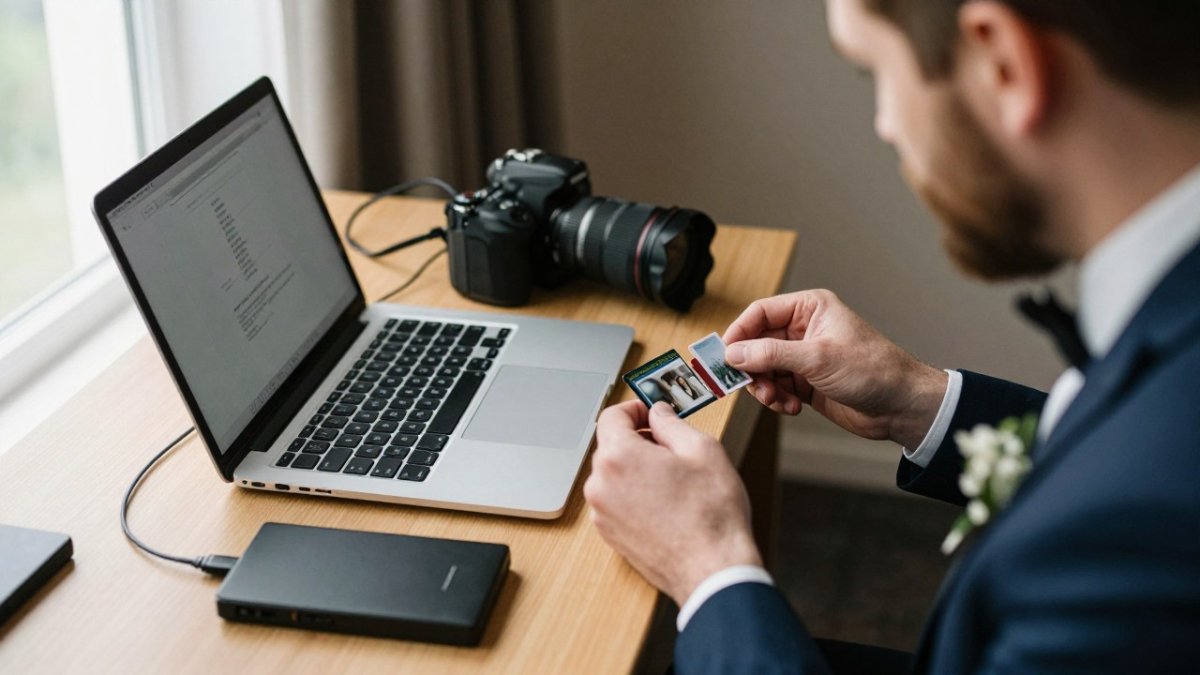
- Before the day: format every card in-camera and pack spare cards, a spare camera body and two portable drives.
- During the ceremony: shoot on dual-card cameras so each frame is written twice.
- At the reception: copy cards to the first portable drive, then to a second drive.
- Same night: upload a third copy to encrypted cloud storage.
- Next morning: verify file counts and open a sample from each card, then reformat.
- Editing: work from a copy, never the original.
- Final delivery: hand over the gallery, then retain the master files in secure storage.
That is the 3-2-1 backup rule in practice: three copies, on two types of media, with one kept off-site.
Watch out: deleting a card at the end of the night, before the copies are verified, is a costly mistake. A card is only safe to wipe once you have opened files from every copy.
If you are still deciding how to split your budget between stills and film, ask whether a combined wedding photo and video package is worth it before you commit.
Here is the photo backup workflow we follow, from the morning of the wedding to final delivery.
| Step | What to do |
|---|---|
| Before the day | Format every card in-camera; pack spare cards, camera body, two drives |
| During the ceremony | Shoot on dual-card cameras so each frame is written twice |
| At the reception | Copy cards to the first portable drive, then a second |
| Same night | Upload a third copy to encrypted cloud storage |
| Next morning | Verify file counts, open a sample from each card, then reformat |
| Editing | Work from a copy, never the original |
| Final delivery | Hand over the gallery, then retain master files in secure storage |
Wedding video footage backup: dual-card recording and redundant capture
Wedding video footage backup starts in the camera, not on a laptop.
Video files are bigger and less forgiving than photos. A dropped clip is gone. So we build redundancy into the capture itself:
- Dual-card recording on every camera body.
- A spare camera on site, charged and carded.
- A second shooter where the day allows, filming key moments from another angle.
- Audio recorded twice, on the camera and on a separate recorder.
guidance on storing and preserving digital files safely
A cinematic wedding video is built from long, unbroken takes and clean audio, and a first dance cannot be reshot.
Once you are satisfied your media is safe, the next step is simple: find out how to book wedding media in Clare and lock in your date.
Frequently Asked Questions
How many copies of our wedding photos should a photographer keep?
A reliable wedding media backup plan keeps several copies of the files. The 3-2-1 rule applies here, meaning three copies on two different types of media with one stored off-site. Ask your photographer how they handle copies, and check how long those copies are retained after final delivery.
What happens if a memory card fails during the wedding day?
If a card fails, a photographer should be able to continue shooting with a spare. Ask your photographer how they handle card failure, because that question tells you how seriously they treat it.
How long should wedding photos and videos be stored after delivery?
Many photographers keep archives for a set period before moving them to a different storage format. Ask for the exact retention period and what happens after it ends. Confirm the handoff format before the wedding so nothing depends on a single device.