 How-to
Natural Light Wedding Photography: Techniques for Every Venue
Last Updated: November 1, 2026
Quick Summary
Natural light wedding photography starts with reading the light before you shoot: judge direction, quality and colour temperature as you enter a venue. Then work with the sun rather than against it, using open shade, spot metering for skin and a histogram to protect the white dress. Window light indoors and a light-aware timeline complete the approach.
- Walk into a venue and check window direction, light quality and colour temperature first.
- Against a bright sky, add +1 to +2 EV so faces do not go dark.
- A 3-stop or 6-stop ND filter keeps a wide aperture usable in full sun.
- Position the bride a metre or two back from a window so the light wraps softly.
- Aim to finish the ceremony 60 to 90 minutes before sunset for portrait light.
Table of Contents
- Read the Light Before You Read the Room
- Wedding Photography in Harsh Sunlight: Working With, Not Against, the Sun
- How to Use Window Light for Wedding Photography Indoors
- Natural Light Bridal Portraits: Posing, Exposure and Skin Tones
- Wedding Photography Without Flash: Ceremonies, Receptions and Backup Plans
- Post-Processing and Client Communication for Natural Light Work
- Frequently Asked Questions
Read the Light Before You Read the Room
Light reading means judging three things in one pass:
- Direction: where the light comes from
- Quality: soft or hard
- Colour temperature: warm or cool
Walk into a church or hotel ballroom and glance at the windows. Behind the altar? To the side?
Direction shapes the face.
Quality decides the mood. Diffused overcast light wraps around people; harsh sun makes hard shadows you must manage.
Colour temperature matters more than most couples realise. Daylight shifts from cool blue in open shade to warm gold at golden hour.
Wedding Photography in Harsh Sunlight: Working With, Not Against, the Sun
Wedding photography in harsh sunlight is the test most couples worry about, and it is manageable. Stop fighting the sun and start using it.
Read the sun before you pose
Hard midday light creates harsh shadows and dynamic range beyond most sensors. Before you move anyone, judge the sun's angle and height. Overhead noon sun can cast harsh shadows under the eyes; low late-afternoon side sun shapes the cheekbones. If the sun is overhead, change the angle, move the couple, or move yourself.
Shade first, then modify
Open shade under a tree, archway or hotel colonnade gives soft, even light without flash. Two cautions: dappled shade throws patches of sun across faces, so find a clean pool of shadow; and deep shade against a bright background fools your meter into overexposing the background.
When you cannot find shade, create it. A reflector held above and slightly in front of the couple can soften harsh top light into directional light.
Settings that survive direct sun
- Meter for skin, not the scene. Switch to spot metering and meter the face, or use evaluative metering and dial in exposure compensation. Against a bright sky, expect to add +1 to +2 EV to keep faces from going dark.
- Protect highlights. Check the histogram, not the screen. Keep the white dress just short of clipping, a small blink of specular highlight is fine, a blown gown is not. Shoot RAW so you can pull detail back later.
- Use a fast shutter and a neutral density filter. At f/1.8 in full sun you may exceed your camera's maximum shutter speed. A 3-stop or 6-stop ND filter lets you keep a wide aperture for shallow depth of field without overexposing.
Work the angles deliberately
- Backlight for glow. Sun behind the couple, expose for faces, shade the lens to keep contrast.
- Silhouette when it suits. Expose for the sky and let the couple go dark, powerful for a first look or wide venue shot, wrong for a portrait needing expression.
- Turn the couple so shadows fall away. A 45-degree turn to the light gives shape without heavy shadow under the nose.
Gear that earns its place in bright light
A fast prime (35mm or 50mm at f/1.4-f/2) gives separation and low-light headroom, but in full sun you will need the ND filter above. A polariser can cut glare on skin and glass and deepen skies, though it reduces the light reaching the sensor.
The key settings and gear choices for shooting in direct sun, as the article lays them out.
| Item | Value | Note |
|---|---|---|
| Exposure compensation against bright sky | +1 to +2 EV | Keeps faces from going dark |
| ND filter strength | 3-stop or 6-stop | Keeps wide aperture in full sun |
| Fast prime aperture | f/1.4-f/2 | Separation and low-light headroom |
| Couple turn to the light | 45 degrees | Shape without heavy shadow under the nose |
| Highlight check | Histogram | Keep white dress just short of clipping |
| Metering mode | Spot metering | Meter the face, not the scene |
How to Use Window Light for Wedding Photography Indoors
Knowing how to use window light for wedding photography turns any room into a studio.
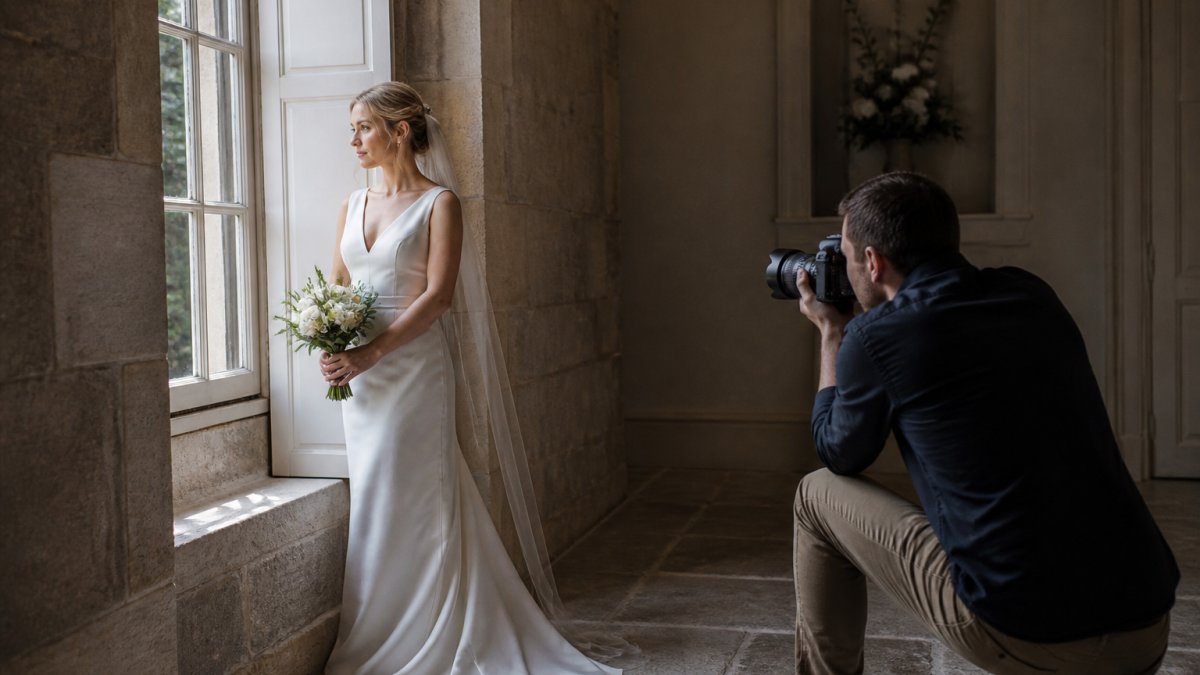
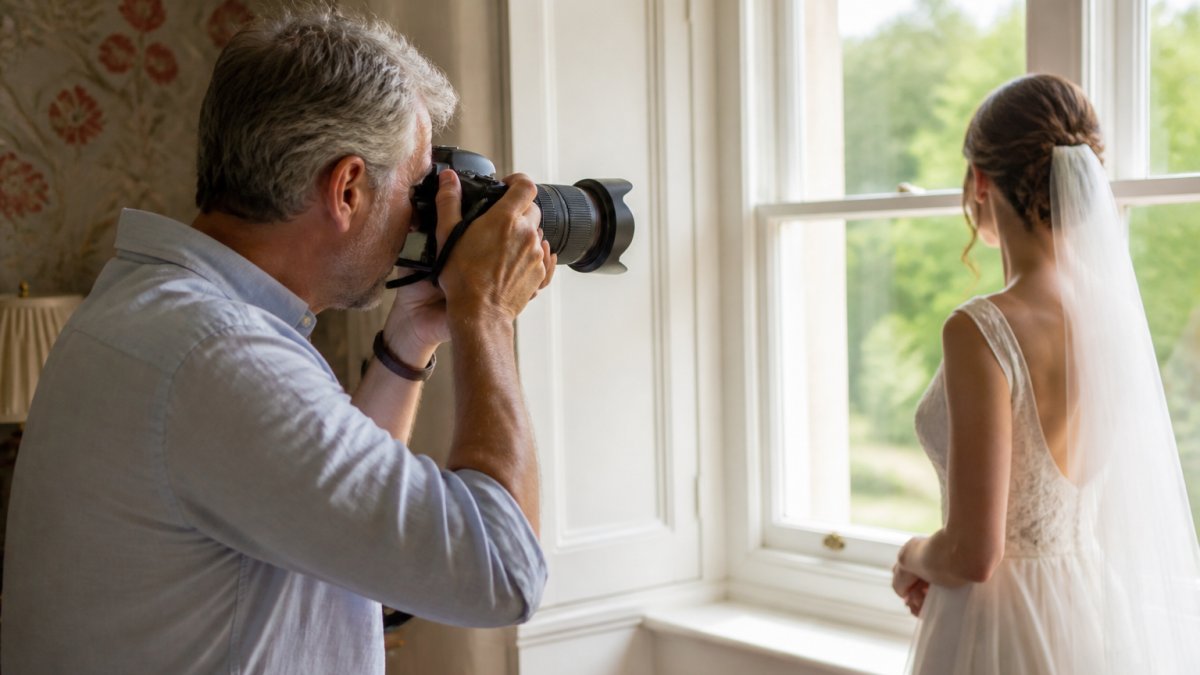
Position the bride a metre or two back from the glass. Too close and the light turns harsh and directional. Step back and it wraps softly around her.
Turn her shoulder toward the window so light falls across the face at an angle, giving shape without heavy shadow.
Then watch the background. A dark wall behind her makes the light on her face sing.
For detail shots, move the dress, rings or bouquet into the window pool. Ambient light does the rest.
Natural Light Bridal Portraits: Posing, Exposure and Skin Tones
Natural light bridal portraits live or die on skin tones. Get the exposure right and everything else follows.
Meter for the face, not the dress. A white gown pulls your meter toward underexposure every time.
Skin tones stay truest when you:
- Avoid mixed light where tungsten and daylight collide
- Set white balance manually for the dominant source
- Keep ISO low for clean skin and better dynamic range
Posing matters as much as settings. Giving shy couples something to do, such as holding hands, whispering, or walking toward the camera, can help. Movement can look natural and help ease nerves.
Wedding Photography Without Flash: Ceremonies, Receptions and Backup Plans
Wedding photography without flash is possible, but it needs planning.
In a dim church, push ISO and accept a little grain.
Candlelit ceremonies need care. Candlelight is warm and weak, so expose for faces and let the candles glow.
Receptions are the real challenge. String lights and uplighters give you pools of warm light.
Watch out: no flash means no safety net in near-darkness.
Post-Processing and Client Communication for Natural Light Work
Most natural light guides stop at capture. The finish happens in the edit, and the best light happens before the day, in the conversation with the couple.
A RAW-first editing workflow that keeps images looking natural
Shoot RAW where possible. A JPEG bakes in the camera's contrast and white balance, which limits how much highlight and shadow detail can be recovered later.
A repeatable order of operations helps keep edits consistent:
- Set the profile and white balance first. Apply the camera-matching profile so you edit from a neutral base. Correct white balance for the dominant source, daylight in a church, tungsten in a reception, before touching tone. Warming a golden-hour frame is often enough; pushing it too far can turn skin orange.
- Recover highlights, then lift shadows. Pull Highlights down until dress detail returns, then raise Shadows gently. If the shadow slider pulls noise out of a dark suit, stop and use a local adjustment instead.
- Protect skin with local masks. Use a subject or skin-tone mask to keep exposure and texture on faces consistent while you grade the background.
- Add contrast with curves, not clarity. A gentle S-curve restores punch without the halo heavy Clarity introduces. Keep Clarity modest for portraits.
- Colour-grade for mood, not fashion. Split-tone subtly, warmth in highlights, cool in shadows, rather than a heavy preset. The goal is a frame that looks like the day felt, not a filter.
Gear limits, stated honestly
A fast prime at f/1.4 gathers far more light than a kit zoom at f/5.6, but it will not match a bounced flash in near-darkness. Be straight with couples about that. If the ceremony is in a dim stone church at 4pm in December, explain that images will carry some grain and a small flash may be needed for the recessional. Couples forgive limitations they were warned about; they do not forgive surprises.
Coaching couples on timing before the day
This is where natural light is won or lost: help the couple choose their ceremony time around the light.
- Work backwards from sunset. Ask for the ceremony start time and venue, then calculate when golden hour lands. A ceremony finishing 60-90 minutes before sunset gives portrait time in the best light; one finishing at sunset gives you darkness.
- Flag the winter problem early. In Ireland, sunset in December falls early in the afternoon, so a mid-afternoon winter ceremony can leave little natural light for portraits. Raise it at booking and agree a plan: bring portraits forward, or accept a flash-lit set.
- Recon the venue at the ceremony hour. Visit at the same time of day as the wedding, not at midday. A church gloomy at 11am may be full of window light at 3pm, and vice versa. Note where light falls on the altar, aisle and exit.
One couple said having both photography and video handled by one local team, with real knowledge of the venue, was the best decision they made.
Frequently Asked Questions
What is natural light wedding photography?
It means working with the light already in the room or the sky, rather than adding flash. The photographer reads direction, quality and colour temperature, then sets aperture, shutter speed and ISO to suit. Natural light wedding photography keeps skin tones soft and expressions relaxed because nobody is being blinded by a strobe. It does demand planning: window positions, ceremony times and venue orientation all get checked before the day, and a backup plan for genuinely dark rooms is agreed in advance.
How do you take wedding photos in harsh sunlight?
Move the couple into open shade or turn them so the sun rakes across from behind at roughly 45 degrees, which gives backlighting and a soft rim rather than flat front light. Shooting in RAW helps recover highlights, and metering for the brighter side of the face with exposure compensation helps hold detail. Midday sun in an open field is the hardest case, so plan portraits for the hour before golden hour where the schedule allows, and use a building or tree line as a shade wall.
Can you photograph a wedding without flash?
Yes, for most of the day. Modern sensors handle higher ISO settings well, and fast prime lenses let in more existing light for candlelit ceremonies and first dances. The limits are real: a very dark church, a marquee at night or a black-ceiling reception room may need a small amount of fill. Wedding photography without flash works best when the schedule, the aisle route and the room layout are reviewed beforehand so the hard moments are known in advance.
How do you keep wedding photos natural and candid?
Give people something to do rather than a pose to hold. A short walk, a quiet word between the couple or a prompt to look at each other instead of the lens produces expressions that hold up. Natural light helps here too: soft, diffused light means no squinting and no flinching at a flash. On the day, the best candid frames usually come from staying close to the action during prep, the aisle and the speeches, and staying quiet enough that guests forget the camera is there.
Natural light is unforgiving, but it is also honest, and that is why we build our whole approach around it. If you are planning a wedding in County Clare and want photography that reads the room before it reads a pose, Philip Nevin can help. Our team brings 36 years of experience, dual photography and video coverage, and deep knowledge of every venue and church in the county. Get started with Philip Nevin and book your date for candid, unposed coverage of your day.